
There's a moment in almost every Game Master's career when you realize that the adventure you've spent the week preparing is no longer the adventure your players intend to play.
Sometimes it happens gradually. The party becomes interested in an NPC you barely described, starts asking questions about a place you never expected them to visit, or develops a theory about the villain that's considerably more interesting than the one you wrote. Other times, it's spectacular. You introduce an ancient prophecy, carefully establish the location of the next dungeon, and watch five enthusiastic adventurers decide that the real mystery is why a particular fisherman refuses to sell his boat.
You have nothing prepared about the fisherman. You invented him approximately forty seconds ago because someone asked whether there were any boats in the harbor.
Now the entire table is looking at you.
The temptation is to bring everyone back to the adventure you planned. After all, you've prepared maps, encounters, NPCs, and several pages of notes. It would be a shame to waste them.
But before you start inventing reasons why the fisherman happens to know the location of the ancient temple, take a breath. The session isn't ruined, and you don't necessarily need to abandon your preparation. You just need to work out what matters in the situation and how the world would respond to what your players have decided to do.
First, figure out what the players are actually interested in
When a party heads somewhere unexpected, it's worth asking why. Players rarely abandon a promising situation for absolutely no reason, even if their reasoning seems questionable from behind the GM screen.
Perhaps you mentioned that the fisherman looked nervous when the harbor master arrived. To you, that was a bit of improvised atmosphere. To the players, it sounded like a clue. Maybe they simply liked his personality, or perhaps they've become suspicious of the harbor authorities after several sessions dealing with corrupt officials.
Their decision tells you something about what has caught their attention.
You don't have to turn every accidental detail into a major revelation. That would make the campaign exhausting to run, and eventually every shopkeeper would become part of an international conspiracy. But understanding what the players find interesting gives you something useful to work with.
Ask yourself whether their new direction connects to an existing element of the adventure. If it does, you may be able to build on something you've already prepared. If it doesn't, you can still give the interaction a satisfying response without transforming it into an entirely new storyline.
The fisherman might simply be nervous because he's operating without a permit. That's a perfectly reasonable answer, and the players may enjoy discovering that their elaborate investigation uncovered a minor licensing dispute.
Not everything needs to be important.
You don't need to invent an entire adventure on the spot
One of the most common mistakes when improvising is assuming that an unexpected decision requires an equally elaborate response. The players ask about a stranger, and suddenly you feel compelled to invent their family history, secret allegiance, personal tragedy, and connection to the main villain.
Most of the time, you only need enough information to handle the immediate interaction.
For an improvised NPC, I usually start with three questions:
- What does this person want right now?
- What are they worried about?
- How will they react if the characters interfere?
Let's try that with our fisherman.
His name is Tomas Reed. He wants to sell enough fish to pay the harbor fees, he's worried that someone will discover the illegal cargo hidden beneath his boat, and he becomes defensive when strangers ask too many questions.
We now have a character who can respond convincingly to the party. We don't yet need to know where Tomas was born, how many siblings he has, or whether he appeared in the campaign's historical timeline.
Those details can wait until they matter.
The same principle applies to locations. If the party unexpectedly visits an old warehouse, give the place a clear purpose, a few distinctive details, and something they can interact with. You can develop the rest if the situation becomes important.
Reuse your preparation without pretending every road leads to the same place
There's nothing wrong with adapting material you've already written. In fact, the ability to reuse good preparation is one of the most useful skills a Game Master can develop.
Suppose you prepared a confrontation with smugglers near the abandoned temple. The players have ignored the temple and become interested in suspicious activity at the harbor. You might realize that the same smuggling organization could reasonably operate in both places.
That doesn't mean the smugglers should magically appear wherever the players go. It means you've discovered a plausible connection between two parts of the setting.
Perhaps the cargo Tomas is carrying belongs to the smugglers. Perhaps he knows which ships they use, or perhaps he's been transporting supplies without understanding what they contain. Any of those possibilities gives the party a new way into an existing conflict.
The important distinction is whether the connection makes sense in the world.
If the players deliberately avoid a dangerous road, don't immediately move the exact same ambush onto the safe road unless there's a believable reason for it. They made a decision based on the information you gave them, and that decision should mean something. We went further into that question in railroad or sandbox?
You can reuse maps, enemy statistics, NPC personalities, and encounters without taking away the consequences of player choices.
Preparation is a collection of resources, not a contract requiring every scene to happen exactly as written.
When you're stuck, let the world make the next move
One of the easiest ways to improvise is to stop asking what the players are supposed to do next and start asking what the other people in the setting are doing.
Your villain has plans. Local factions have interests. NPCs want things, fear things, and react when their circumstances change. None of them needs to wait patiently for the party to arrive at the correct scene.
Imagine that the players spend the evening investigating Tomas rather than visiting the temple. That's their decision, and you can let the investigation play out.
Meanwhile, the cult operating beneath the temple continues its preparations. A messenger leaves the ruins, a frightened villager disappears, or someone reports strange lights in the hills.
You don't need to interrupt the players and announce that they're following the wrong story. Simply allow events to develop.
Later, the consequences of those events may bring the original problem back into focus. The party might discover that the cult completed part of its ritual while they were occupied at the harbor, or that someone they trusted has disappeared.
Now the next development follows logically from what happened at the table.
The world hasn't forced the players back onto a predetermined path. It has continued moving while they were doing something else.
Make the unexpected scene worth playing
There's a difference between allowing players to pursue an idea and making every unexpected detour an hour-long conversation without any meaningful outcome.
If the party decides to interrogate the fisherman, give the interaction something to resolve. They might discover the hidden cargo, earn his trust, make an enemy of the harbor master, or decide that they were wrong about him.
Whatever happens, the scene should change something, even if that change is relatively small.
A useful way to think about improvised encounters is to give them a question.
Will Tomas admit that he's carrying illegal goods? Can the party convince him to reveal who hired him? Will their interrogation attract the attention of the harbor guards?
You don't need to know the answer in advance. The answer emerges from what the players attempt and how the characters involved react.
This is especially helpful during investigative adventures, where an unexpected conversation can become more interesting than the carefully prepared scene you thought would be the highlight of the evening.
Keep track of what you invent
Improvisation creates another problem that doesn't always become obvious until the following session: you have to remember what you said.
Maybe you named the fisherman Tomas Reed. You decided he had a daughter living in the capital, mentioned that his brother once worked at the temple, and casually introduced an old brass key he keeps around his neck.
None of those details existed before tonight. Unfortunately, your players may remember every one of them.
If Tomas becomes a recurring character, those improvised facts are now part of the campaign. Changing them accidentally can make the world feel inconsistent, especially when the players have based decisions on something you told them.
This is why I find it useful to record new information immediately after an important scene, even if it's only a couple of sentences.
You don't need a complete transcript of the conversation. Write down the character's name, what the party learned, any promises that were made, and whatever might become relevant later.
For longer campaigns, it helps to keep those details connected to the NPCs, locations, and events they belong to.
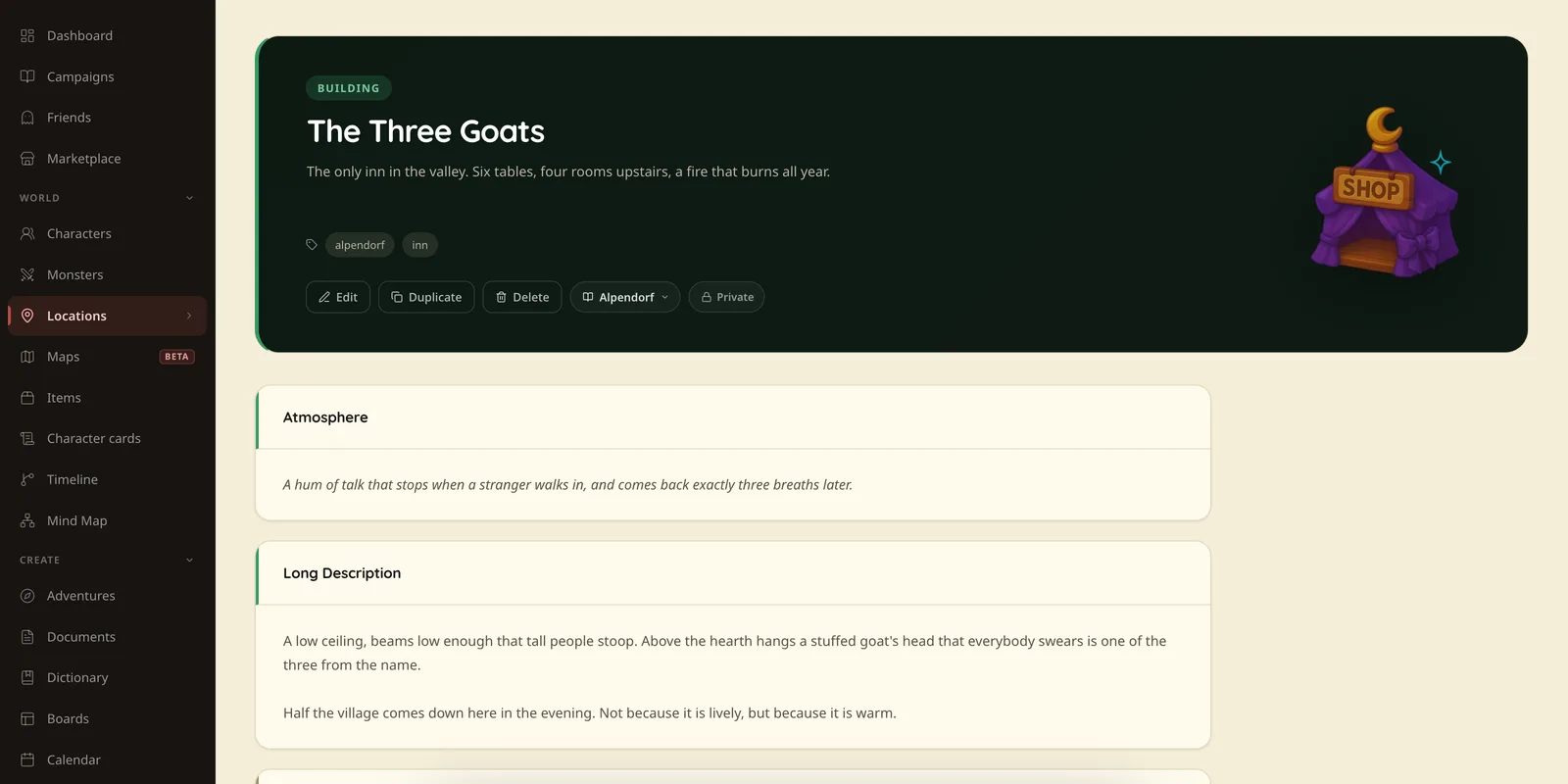
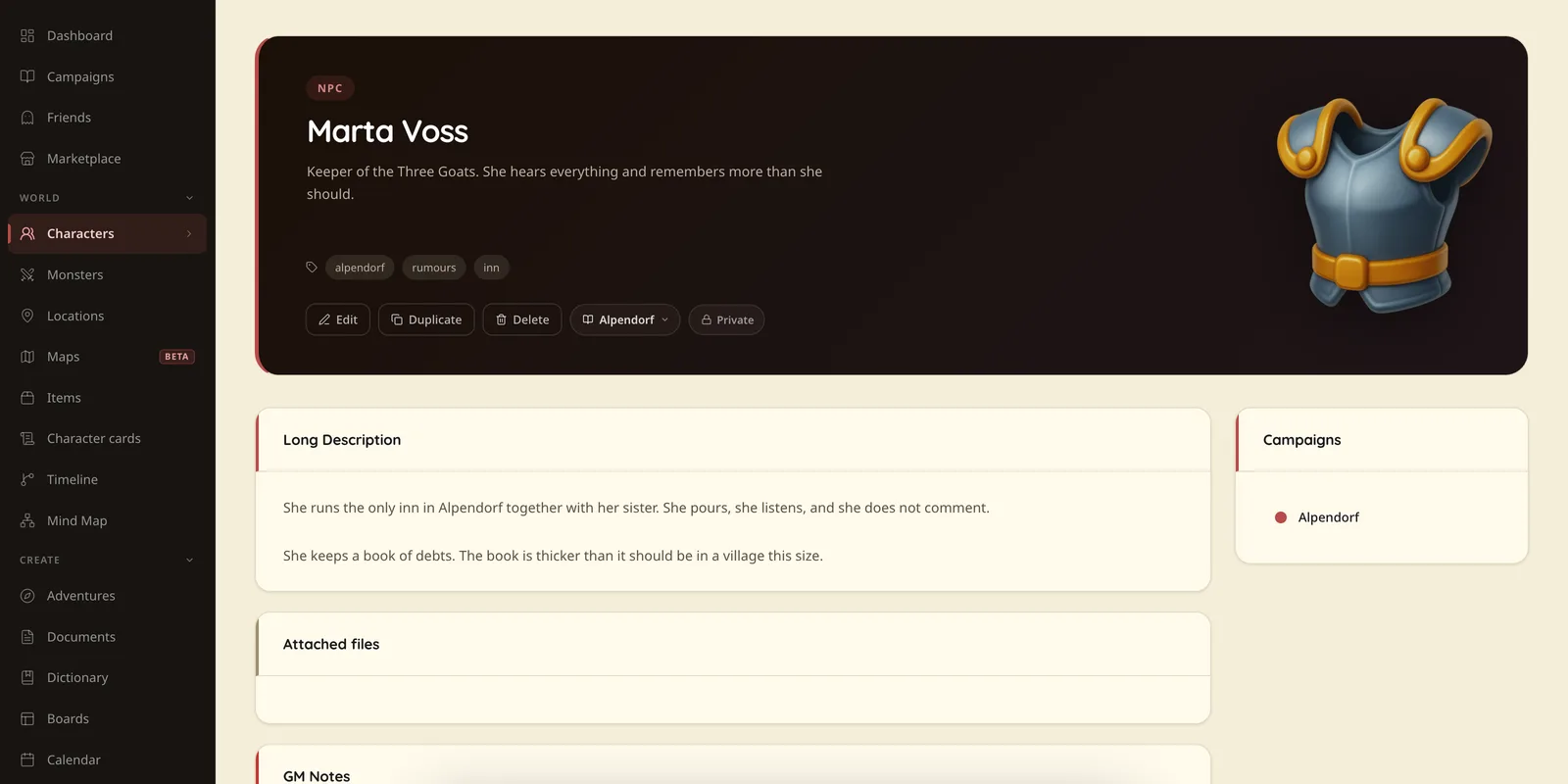
In Talehaven, for example, you can create character and location entries, keep notes associated with your campaign, and use Boards to visualize relationships. The Adventure module also lets you organize scenes alongside the materials you'll need during play. These tools don't improvise for you, but they can make it easier to use your existing preparation in an unexpected order and preserve the details you invent along the way.
If your preferred system is a notebook, that's fine too. The important part is recording enough information that you don't have to reinvent the same character three sessions later.
Sometimes the best response is to admit you need a moment
There's a peculiar pressure that comes with sitting behind the GM screen. The players expect the world to respond to their decisions, so it can feel as though you should have an immediate answer to everything.
You don't.
If the party suddenly decides to travel to a city you've never prepared, it's completely reasonable to ask for a short break. Take five minutes, work out what they'll encounter first, and decide which existing elements of your setting might be relevant.
For a larger change of direction, you can even discuss it between sessions. If everyone wants to abandon the current expedition and sail to another continent, there's nothing wrong with asking them to confirm that plan so you can prepare something worthwhile for the next game.
Being a good Game Master doesn't mean generating an entire fictional universe in real time without ever hesitating.
It means being able to respond to the players honestly, maintain the internal logic of the setting, and give their decisions meaningful consequences.
Sometimes that takes a moment of thought.
A five-minute rescue plan for an unexpected detour
When the players make a decision you didn't prepare for, try this before reaching for another document or inventing a complicated explanation.
Identify what they're trying to accomplish
Are they looking for information, avoiding danger, testing someone's honesty, or simply exploring something that caught their attention? Understanding their intention makes it much easier to give the scene a useful direction.
Choose the people and places that matter
You rarely need more than one or two characters and a location to begin. Give each character an immediate motivation and decide what makes the location interesting.
Look for connections to existing material
A faction, an unresolved problem, an NPC you've already introduced, or a clue the players missed may provide everything you need. If there's no natural connection, don't manufacture one merely to protect your original plan.
Decide what changes if the players succeed or fail
An improvised encounter becomes meaningful when it produces information, alters a relationship, creates a complication, or changes what happens next.
Record the new facts
Names, promises, discoveries, and consequences are the details most likely to matter later. A few notes written now can save you considerable confusion next session.
That approach won't solve every situation, but it gives you a reliable starting point when everyone is waiting for the world to respond.
The session you didn't prepare may be the one they remember
Some of the best moments in tabletop RPGs happen because the players noticed something the GM considered unimportant.
A nameless guard becomes a recurring ally. A minor argument with a merchant develops into a feud that lasts half the campaign. A harmless remark about an abandoned building sends the party on an investigation nobody expected.
Those moments aren't necessarily evidence that the GM failed to prepare properly. Often, they demonstrate that the players are genuinely interested in the world and believe their decisions can affect it.
Good preparation still matters. Interesting NPCs, coherent locations, believable conflicts, and a sense of what might happen next give you material to work with when the party changes direction.
But preparation becomes much more useful when you're willing to treat it as something flexible.
The next time your players decide to investigate a fisherman instead of visiting the dungeon you spent three hours preparing, don't panic. Find out what interests them, give the situation room to develop, and see whether your existing material offers a natural connection.
You might get them to the temple eventually.
Or you might discover that the fisherman has become the most interesting person in the campaign.
Either way, you still have a game to run.